Getting Your Blue Belt (and Beyond)
What do you need to do to earn a Blue Belt?
Getting Your BJJ Blue Belt And Beyond
What do you need to do to earn a Blue Belt?
By Elvis Sinosic, UFC Veteran & 5th Degree BJJ Black Belt · Published Nov 18, 2026
Quick answer: Most adults at Kings Academy earn their Brazilian Jiu Jitsu blue belt in 1 to 2 years of consistent training. A beginner usually earns a stripe about every 3 months, and there are four stripes on the white belt. Your blue belt is presented when your coaches see you can apply the full white belt syllabus in live rolling, not on a set date.
Earning your blue belt shows that you have both an attack and a defence from every fundamental position: guard, side control, mount and back control, plus defences from turtle, half guard and the headlock. These are the positions you'll find yourself in most often as a beginner. Being able to escape, control and submit from each of them is what gives you real confidence on the mats.
Having these fundamental skills is the foundation for all the advanced principles and skills you will learn as you progress in BJJ.
"How long until I get my blue belt?" is one of the most common questions we hear from new students. The honest answer is that it depends on you.
The BJJ belt system is famously slow, and that's a good thing. A BJJ belt means you can make the techniques work against a resisting partner, not just remember them. That's why a blue belt means so much when you finally tie it on.
This guide explains the IBJJF belt system we follow at Kings Academy, how long each belt typically takes, an overview of what our Gi and No-Gi syllabi ask of you at each stage, and what it really takes to go from white belt to blue and beyond.
The BJJ belt system: belt by belt
For adults (16 and over), the IBJJF belt order is White → Blue → Purple → Brown → Black. After black belt come degrees, then the coral belts and finally the red belt, which are reserved for people who have given decades to the art.
White, blue, purple and brown belts each carry four stripes. Stripes mark your progress within a belt, so you're never more than a few months from your next goal.
White Belt
- IBJJF minimum age: Any age
- IBJJF minimum time at this belt (18+): No minimum
- Typical total training time: Starting point (blue usually comes after 1–2 years)
- What this belt means: Survival, escapes, core positions and your first submissions
Blue Belt
- IBJJF minimum age: 16
- IBJJF minimum time at this belt (18+): 2 years
- Typical total training time: 1–2 years to reach
- What this belt means: A broad toolbox. You can escape, sweep, pass and submit against resistance
Purple Belt
- IBJJF minimum age: 16
- IBJJF minimum time at this belt (18+): 1.5 years
- Typical total training time: Around 3–5 years to reach
- What this belt means: Linking techniques into your own game, and helping newer students
Brown Belt
- IBJJF minimum age: 18
- IBJJF minimum time at this belt (18+): 1 year
- Typical total training time: Around 5–7 years to reach
- What this belt means: Refining your game and defending everything you know at a high level
Black Belt
- IBJJF minimum age: 19
- IBJJF minimum time at this belt: 1st degree after 3 years as a black belt
- Typical total training time: Around 8–15 years to reach
- What this belt means: Mastery of the fundamentals and the ability to teach them
Minimum ages and times come from the IBJJF Graduation System. The IBJJF waives the minimum time for adult World Champions at blue, purple and brown belt. "Typical" times are general estimates and vary a lot from person to person.
[Link "IBJJF Graduation System" to: https://ibjjf.com/graduation-system]
The minimum times are a floor, not a target. Most students spend longer than the minimum at each belt, and that's completely normal.
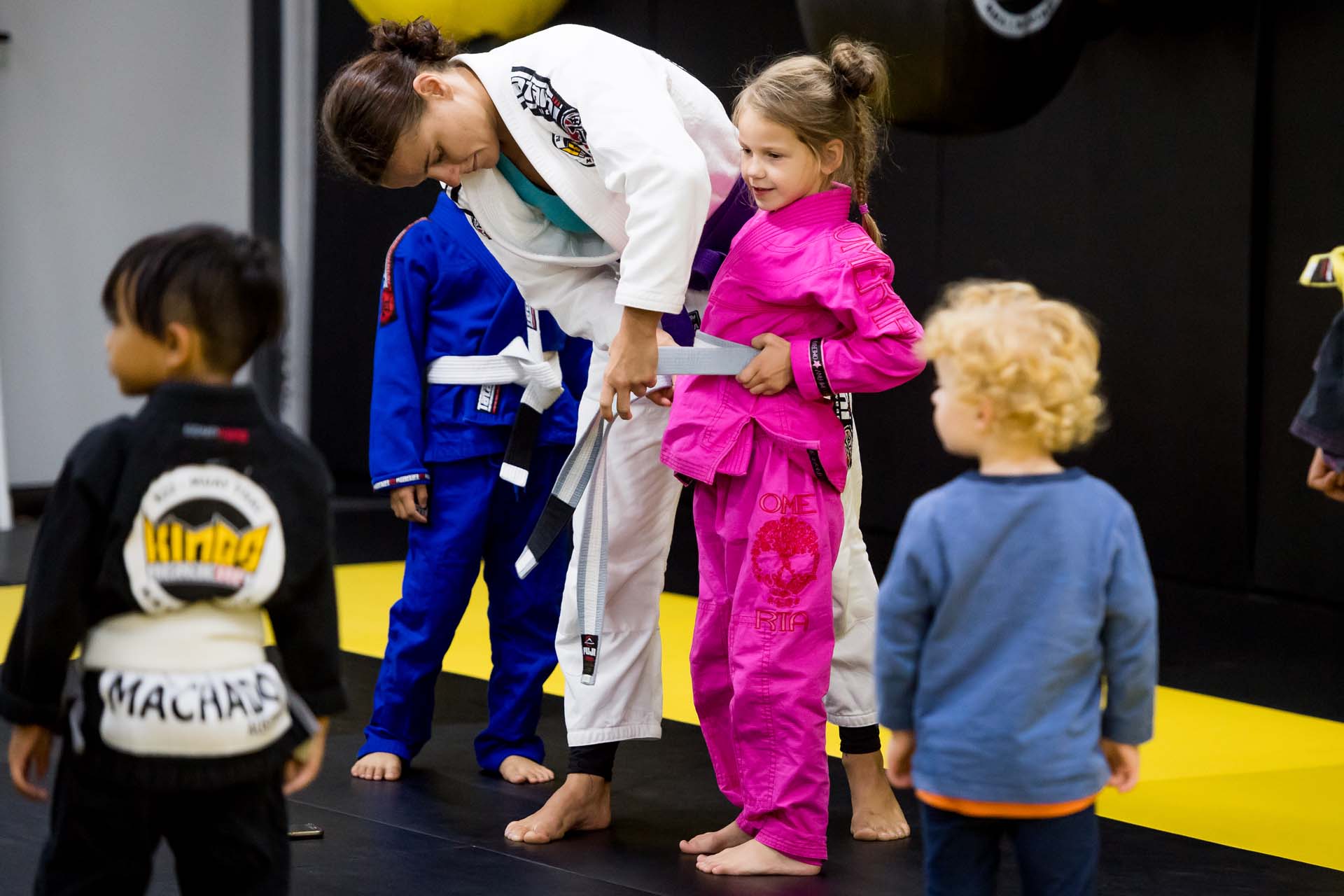
Kids have their own belts. Students aged 3 to 15 progress through grey, yellow, orange and green belts, each with white, solid and black versions. Kings Academy has a kids syllabus (6–12 years) and a teens syllabus (13–16 years). At 16 they move into the adult system and syllabus, and their coach decides which adult belt fits their skill.
The techniques on all 3 syllabuses are the same. The difference is how we teach them and how many you need to demonstrate at each stripe grading. So regardless of the age you begin, you'll be learning the same effective, tried and tested techniques. See our Kids Martial Arts program.
The road to blue belt at Kings Academy
White belt is about learning to survive, control and move. Chief Instructor Elvis has a core principle that he always teaches to beginners. This is the principle of progression, and it sets out what your goals should be:
1. Learn to be comfortable being uncomfortable.
BJJ is full of uncomfortable positions, and learning to accept them and stay safe is the first and most important skill.
2. Learn how not to get submitted while surviving.
3. Learn to escape the position.
4. Learn to get to a neutral position.
5. Learn not to get reversed.
6. Learn to get to a dominant position.
7. Learn to maintain the dominant position.
8. Finally, learn how to submit your opponent.
This isn't the order you'll learn skills and techniques, but rather the goal of progression to give you the greatest chance of success in BJJ.
Our white-to-blue syllabus is split into four stripes, so you always know exactly what you're working on next.
Typical timing for an adult training regularly:
- 1st stripe: About 3 months
- 2nd stripe: About 6 months
- 3rd stripe: About 9 months
- 4th stripe: About 12 months
- Blue belt: Usually 1 to 2 years in total
How grading works
We grade students for stripes, and belts are presented when you're ready. To earn a stripe, you'll be expected to:
- Show each technique cleanly on a cooperative partner
- Understand the position and the "why" behind the move
- Apply the same techniques, or logical variations, in live rolling
- Keep good training habits, a good attitude and respect for your partners
Elvis and the coaches assess the full package. A student who can perform every move perfectly but rarely trains, shows poor mat manners or can't apply anything under pressure won't be promoted.
What you learn, stripe by stripe
Now this isn't all that you'll learn. You'll learn a variety of techniques based on your level. At Kings we stay up to date with the latest techniques as the evolve around the world. This is what you're expected to learn to successfully grade. Classes cover both syllabus and non-syllabus techniques.
1st stripe: positions and movement. Five foundation drills teach you how to hold and move between the dominant positions: the mount drill, top control drill, basic circuit (bridge and roll, guard pass, mount), side control drill and knee-ride drill.
2nd stripe: the guard and your first submissions. Breaking and maintaining guard posture, the technical stand-up, the armbar and figure-4 armlock (Americana) from mount, the guillotine, your first sweeps, and the core escapes from mount, side control and the back.
3rd stripe: submissions, passing and takedowns. Armlocks and chokes from side control and guard, the rear naked choke, the standing and half guard passes, back control escapes, the cross-ankle lock and the major outer reap (Osoto-gari) takedown.
4th stripe: filling the gaps. The Kimura, armbars from knee-ride, the triangle choke, the knee-through guard pass, headlock escapes, the straight ankle lock and the double leg takedown.
Blue belt promotion. You should be able to demonstrate the techniques from all four stripes, then put together combinations. Combinations show you can link techniques together instead of performing isolated moves. You should have both an attack and a defence from all the fundamental positions to be an effective blue belt.
The fundamentals you learn here are the same ones black belts still rely on. Read more on the importance of fundamental skills in Brazilian Jiu Jitsu.
Gi and No-Gi: same belts, different details
Kings Academy runs a Gi syllabus and a No-Gi syllabus. Both use the same IBJJF belt ranks and stripes, and the core concepts overlap: mount control, escapes, fundamental submissions and positional drills. The grips, entries and finishes differ.
Without a Gi there are no lapel chokes, so the No-Gi syllabus adds more wrestling and control: single and double leg takedown defence, the 2-on-1 headlock escape to the spiral ride, kipping escapes from mount, and the pendulum and flower sweeps.
Not sure which to start with? Read our comparison of Gi vs No-Gi Brazilian Jiu Jitsu.
[Link "Gi vs No-Gi Brazilian Jiu Jitsu" to: https://www.kingsacademy.com.au/gi-vs-no-gi-brazilian-jiu-jitsu-a-comprehensive-comparison]
What makes a blue belt
The difference between a long-term white belt and a new blue belt is rarely "more techniques". It's staying calm under pressure, keeping good posture and frames, recovering guard when you need to, and starting to impose your own game instead of only reacting. It's having an attack and a defence from all the fundamental positions. This is the foundation for everything else you will learn.
How to progress faster (and what our coaches look for)
The syllabus is the map. The coaches decide when you've reached the destination, and they watch you over months of training, not on a single test day. Here's what moves you forward:
1. Train consistently. Two to three classes a week over a long period beats short bursts of intense training. Once a week works, but it takes longer.
2. Drill with intention. The syllabus drills build the positional awareness that shows up in live rolling.
3. Roll with a purpose. Spend some rounds working a specific position or technique from your syllabus instead of only trying to "win".
4. Ask questions and get feedback. Coaches notice students who actively work on their weaknesses.
5. Turn up to your gradings. Stripes only come when you grade for them.
6. Be a good training partner. How you treat others and handle frustration is part of the grading criteria.
7. Look after your body. Rest, recover and train safely. Time off with an injury is the biggest progress killer.
8. Consider competing. It's never required, but competition often speeds up progress because the pressure exposes gaps that casual rolling can hide.
Your background matters too. Wrestling, Judo or other grappling experience usually shortens the road to blue.
Elvis has always emphasised fundamentals: fancy moves mean little if the basics aren't solid. The students who progress most reliably treat every class as a chance to sharpen the simple things under more and more pressure. This doesn't mean you won't learn fancy or advanced moves, rather you'll develop strong fundamental skills that allow you to excel when you get to advanced techniques.
Beyond blue belt: purple, brown and black
Blue belt is your first major milestone, not the finish line. From here the focus shifts from survival to building a complete game of your own, and the real enjoyment begins.
Blue to purple. Your toolbox grows fast. Each stripe on our blue-to-purple syllabus covers every part of the game:
- Guard passes: torreando, X-pass, double-under, over-under, knee slice and half guard backstep passes
- Sweeps: butterfly, half guard, leg lasso, flower, X-guard and single leg X sweeps
- Submissions: the arm triangle, omoplata, teepee choke and bow and arrow choke, plus more armbar variations from top and guard
- Leg locks: the belly-down straight ankle lock, kneebar, toe hold and heel hook entries
- Takedowns and escapes: the hip throw and bear hug takedown, with new escapes from mount, side control and knee-ride
The purple belt grading again asks for an understanding of combinations across sweeps, guard submissions, passes, top submissions and escapes. The IBJJF requires adults to spend at least 2 years at blue belt, so this is the stage where patience matters most.
Purple to brown. Purple belts add deeper leg entanglements (heel hooks, calf slicer and the Estima lock), advanced guards (De La Riva, X-guard, spider, 50/50 and deep half), stronger top pressure and submissions (D'Arce, anaconda, crucifix and clock choke) and higher-level escapes. The IBJJF minimum at purple is 1.5 years.
Brown to black. Brown belt asks you to defend everything you already know at a high level: sweeps, passes, chokes, armlocks and leg locks. You'll also show grip breaks, takedown counters and advanced combinations such as double-shot armbars. The IBJJF minimum at brown is 1 year, though most people spend much longer at brown belt unless they're active competitors.
The higher the belt, the higher the expectations for teaching, leadership on the mats and solving problems rather than just executing moves. But at every belt, the formula stays the same: show the techniques, apply them live, train consistently and carry yourself with the right attitude.
Frequently asked questions
Can you get a BJJ blue belt in 1 year?
Yes, if you train consistently, grade for each stripe, compete regularly, and can apply the syllabus in live rolling as well as in competition. For most adults, 18 months to 2 years is typical.
How many stripes are on a BJJ belt?
White, blue, purple and brown belts each have four stripes. At Kings Academy, a beginner usually earns a stripe about every 3 months. At the higher belts, it's usually every 6 months.
Is there a minimum time at white belt?
No. The IBJJF sets no minimum time at white belt. Your coaches decide when you're ready for blue.
How long do you have to stay at blue belt?
The IBJJF requires adults to spend at least 2 years at blue belt before promotion to purple.
How old do you need to be to get a BJJ blue belt?
The IBJJF minimum age for blue belt is 16. Younger students progress through the kids belts and move into the adult ranks at 16. It's never too late to start, either: read our guide on the best age to start Brazilian Jiu Jitsu.
[Link "the best age to start Brazilian Jiu Jitsu" to: https://www.kingsacademy.com.au/whats-the-best-age-to-start-brazilian-jiu-jitsu-bjj]
Do Gi and No-Gi students get the same belts?
Yes. At Kings Academy, both programs use the same IBJJF belt ranks and stripes, with a separate syllabus for each.
Do I have to compete to get promoted?
No. Competition is always optional. Many students who compete progress faster, but consistency, live application and attitude are what earn your belt.
How many times a week should I train to get my blue belt?
Two to three classes a week is ideal for steady progress. More training helps, as long as you recover well. The more mat time you have whether training or competing, the faster you're likely to progress.
Your blue belt starts with one class
Every black belt was once a white belt who decided to keep showing up. Whether you're a complete beginner or a white belt chasing your fourth stripe, the path is the same: consistent training, solid fundamentals and the right attitude.
At Kings Academy in Chipping Norton, you'll learn from a structured Gi and No-Gi syllabus, grade for stripes as you progress, and train under Elvis Sinosic, Australia's first UFC fighter and a 5th Degree BJJ Black Belt under Carlos Machado. We welcome beginners from Liverpool, Moorebank, Casula, Wattle Grove and across South West Sydney.
The only way to find out how far you can go is to start.
What to expect at your first BJJ class
See you on the mats.
Published Nov 18, 2026
Updated Nov 18, 2026